
An LED with a series resistor
Which component limits current?
Hint
The LED itself is not a current limiter.
Answer and working
R1 limits current. Without it, a voltage source can overload the LED.
What voltage appears across R1?
Hint
Source voltage minus LED forward drop.
Answer and working
Calculation notes

What is the LED current?
Hint
I = UR / R1.
Answer and working
Calculation notes


How much power is dissipated in the resistor?
Hint
PR = UR × I.
Answer and working
Calculation notes


Increase R1 to 680 Ω. Calculate and check the LED model.
Hint
The simplified model still gives 3 V across R1.
Answer and working
Calculation notes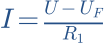
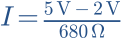

The LED usually becomes dimmer. Brightness is not exactly proportional to current.
Think it through before opening the answer. Always write the formula, substituted values and units.
The mental picture
An LED is not a tiny incandescent bulb with fixed resistance. A small voltage change can cause a large current change. The resistor takes the remaining voltage and limits current.
The principle
Forward voltage depends on colour, technology, temperature and current. On an untrimmed standard LED the longer lead is often the anode, but the datasheet is more reliable. Brightness, current and perceived brightness are not identical linear quantities.
Try it yourself
The LED
Set 5 V, a 2 V forward drop and 330 Ω. Then change the forward drop to 3 V. The same supply and resistor produce a different current.
Model limits: Fixed assumed LED forward voltage and resistive current limiter. No thermal or optical model.
A worked example
With 5 V and an assumed 2 V LED drop, the resistor sees 3 V. A 10 mA target gives 300 Ω. A nearby standard value of 330 Ω produces slightly less current, provided the particular LED is suitable.
A closer look · equations and assumptions
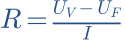


For robust sizing, check the highest supply voltage and lowest plausible forward voltage. That combination gives maximum current. Higher-power LEDs or widely varying supplies often use constant-current drivers. Parallel LEDs sharing one resistor do not automatically share current evenly.
A common pitfall. A microcontroller pin is not an unlimited voltage source. Check pin, port and total current limits as well as output voltage drop.
Workshop takeaway
An indicator often needs less current than expected. Calculate, start low and judge brightness in its actual mounting position.
Sources & transparency
Original illustrations and educational calculations. No measurements of a specific product. Edited 11 October 2026.
Work it out · answers unfold
Write down your prediction first, then your calculation. Open the answer only when you are ready to compare.
04 · LED with assumed 2 V forward drop: 5 V source, target 10 mA. Find series resistor.
Show worked answer
- Resistor must drop 3 V.
- Current in A: 0.01 A.
- R = 300 Ω.

05 · Use 330 Ω instead of 300 Ω. Find LED current and resistor dissipation in the 2 V model.
Show worked answer
- I = 3/330 = 9.09 mA.
- P = 3²/330.
- P = 27.27 mW.

06 · LED forward voltage varies from 1.8 to 2.2 V. Source 5 V, R = 330 Ω. Find current range.
Show worked answer
- Lower forward voltage gives maximum current.
- Maximum I = 3.2/330 = 9.70 mA.
- Minimum I = 2.8/330 = 8.48 mA.

07 · Why is 0.7 V not a universal hard diode turn-on threshold?
Show worked answer
- Current changes continuously with voltage.
- Temperature and diode type affect the curve.
- 0.7 V is a simplified calculation assumption.